Internship – TECHNIQUES IN PLANT SCIENCE
PROGRAMME OVERVIEW
Name of the Department: BOTANY
Name of the internship Programme: TECHNIQUES IN PLANT SCIENCE
Area of specialization: Experimental studies
Name of the Coordinator: Dr. Niranjana M. R.
Duration of the programme: 12days
Industry linkages if any: NIL
Targeted number of participants: 27
Beneficiary departments other than parent department: Biochemistry & Zoology
PROGRAMME DETAILS
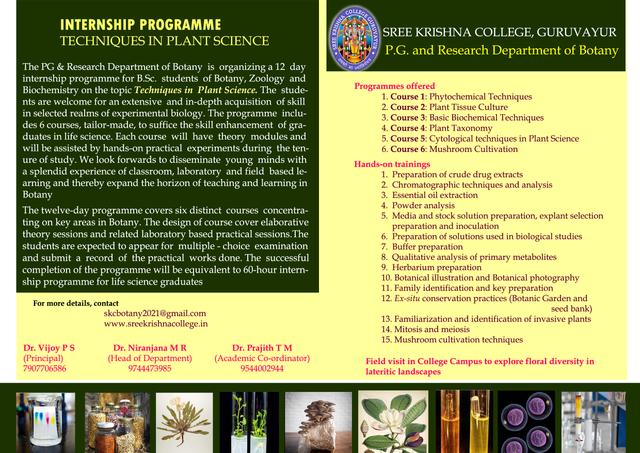
The PG & Research department of Botany is organizing a 12-day internship programme for B.Sc. students of Botany, Zoology & Biochemistry on the topic ‘Techniques in Plant science’. The students are welcome for an extensive and in-depth acquisition of skill in selected realms of experimental biology. The programme includes 6 courses, tailor-made, to suffice the skill enhancement of graduates in life science. Each course will have theory modules and will be assisted by hands-on practical experiments during the tenure of study. We look forward to disseminate young minds with a splendid experience of classroom-, laboratory- and field-based learning and thereby expand the horizon of teaching and learning in Botany
EVALUATION AND ASSESSMENT
The twelve-day programme covers six distinct courses concentrating on key areas in Botany. The design of course covers elaborative theory sessions and related laboratory based practical sessions. The students are expected to appear for a multiple-choice examination and submit a record of the practical works done. The successful completion of the programme will be equivalent to 60-hour internship programme for life science graduates.
TOPICS COVERED
COURSE I
PHYTOCHEMICAL TECHNIQUES
THEORY
Introduction, Major phytochemicals and their importance. Phytochemical screening: Extraction, -solvent polarity, Solvent selection, Qualitative phytochemical analysis of major secondary metabolites. Basic principles and Applications – Paper Chromatography (PC), Thin Layer Chromatography (TLC), Column Chromatography (CC). Analyses of GC and LC data
Hands-On Training
· Preparation of extracts of crude drugs
· Extraction techniques
· Chromatographic Techniques and Analysis of chromatogram
· Essential oil extraction
· Powder analysis
COURSE II
PLANT TISSUE CULTURE
THEORY
Introduction - Basics of Plant Tissue Culture – Laboratory requirements, Media Preparation & Culture Conditions- organ culture, callus generation, organogenesis. Applications
Hands on training
· Media preparation
· Stock solution calculation and preparation
· Surface Sterilization
· Explant selection & preparation
· Inoculation and subculturing
COURSE III
BASIC BIOCHEMICAL TECHNIQUES
THEORY
Solutions: representing concentrations: Molarity, Normality, Percentage and ppm; Preparation of solutions used in biological studies; Qualitative analysis of primary metabolites
Hands on training:
· Preparation of solutions used in biological studies
· Buffer preparation
· Qualitative analysis of primary metabolites: simple sugars, starch, protein
COURSE IV
PLANT TAXONOMY
THEORY
Plant morphology: Vegetative and Floral morphology, Identification of selected plant families by using morphological features, Familiarization of selected floras. Photography- principles and applications
Hands-on training
· Herbarium preparation,
· Botanical illustration
· Family identification
· Key preparation
· Macrophotography as an aid in photography
· Ex-situ conservation practices- Botanic garden & seed banks
· Identification of invasive species
COURSE V
CYTOLOGICAL TECHNIQUES IN PLANT SCIENCE
THEORY
Nucleus - Internal organization, Euchromatin and heterochromatin. (Facultative and constitutive heterochromatin)
Structure and functions of chromosomes-organization, morphology, telomeres, centromeres and kinetochores, nucleolar organizers (NOR), chromomeres. Chromosomal aberrations and effects; Endomitosis and Polyteny
Hands on training
· Staining of Onion root tip – mitosis;
· Staining of anthers – meiosis
· Preparation of acetocarmine
COURSE VI
MUSHROOM CULTIVATION
THEORY
Mushrooms, nutritional and economic potential. Types of cultivated mushrooms, Oyster mushroom cultivation practices
Hands on training
· Medium sterilization
· Bed preparation and spawning
· Culturing and harvesting
EXPECTED OUTCOMES
- Amalgamation of theoretical principles in solving analytical experiments
Demonstrate the ability to integrate and apply academic knowledge and skills to real-world professional environments. - Develop Professional and Technical Skills in diverse areas of plant science
Acquire discipline-specific skills, tools, and technologies relevant to the industry or field of study. - Enhance problem-solving and critical thinking abilities
Identify, analyze, and solve practical problems using appropriate methods and resources.