Chemistry in Water Quality
Introduction
Water quality is determined by assessing three classes of attributes: biological, chemical and physical. There are standards of water quality set for each of these three classes of attributes. The national standards for drinking water are developed by the government's Environmental Protection Agency (EPA). All municipal (public) water supplies must be measured against these standards. Some attributes are considered of primary importance to the quality of drinking water, while others are of secondary importance. Therefore, the EPA drinking water standards are categorized as primary drinking water standards and secondary drinking water standards. Primary drinking water standards regulate organic and inorganic chemicals, microbial pathogens, and radioactive elements that may affect the safety of drinking water. These standards set a limit--the Maximum Contaminant Level (MCL)--on the highest concentrations of certain chemicals allowed in the drinking water supplied by a public water system. Secondary drinking water standards regulate chloride, color, copper, corrosivity, foaming agents, iron, manganese, odor, pH, sulfates, total dissolved solids, and zinc, all of which may affect qualities of drinking water like taste, odor, color, and appearance
Objectives
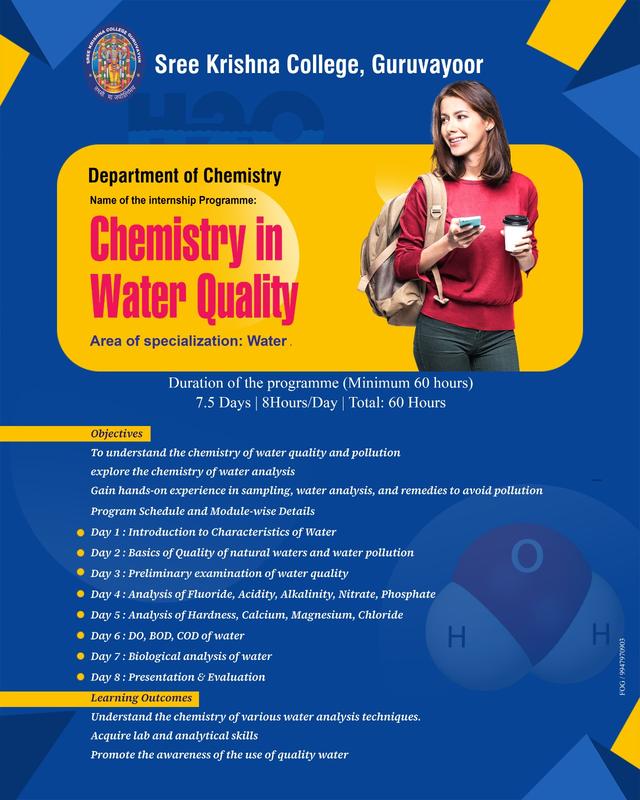
- To understand the chemistry of water quality and pollution
- explore the chemistry of water analysis
- Gain hands-on experience in sampling, water analysis, and remedies to avoid pollution
Program Schedule and Module-wise Details
Introduction to Characteristics of Water
· **Topics Covered:**Sources and uses of water
· **Activities:** Class room Teaching
Basics of Quality of natural waters and water pollution
· **Topics Covered:** Chemistry of water, Major quality characteristics of water, Definition of water pollution, Physical and Chemical Pollution of water, Biological Pollution
· ** Activities:** Class room Teaching
Preliminary examination of water quality
· **Topics Covered:** Colour, Turbidity, Odour, Taste, pH, Electrical conductivity
· **Lab Work:** pH measurement and Electrical conductivity
· **Materials:** Beakers, funnels, pH meter
Analysis of Fluoride, Acidity, Alkalinity, Nitrate, Phosphate
· **Topics Covered:** Determination of Alkalinity, Acidity, Nitrate, Fluoride, by titration method
· **Lab Work:** Analysis of Fluoride, Acidity, Alkalinity, Nitrate, Phosphate
· **Materials:** Burette, Pipette, Conical flask Beakers
Analysis of Hardness, Calcium, Magnesium, Chloride
· **Topics Covered:** Reason for hardness of water, How it can be eliminated
· **Lab/Demo:** Estimate the amount of Ca2+, Mg 2+, Cl- using titration method
· **Materials:** Burette, Pipette, Conical flask Beakers
DO, BOD, COD of water
· **Topics Covered:** How to collect the samples for DO, BOD, COD
· **Lab Work:** Quantitative estimation of DO, BOD, COD
· **Materials:** Burette, Pipette, Conical flask Beakers
Biological analysis of water
· **Topics Covered:** How to do bacteriological test, E Coli Index, Most Probable number method
· **Lab Work:** Culture medium for total bacteria
· **Materials:** Durham tube, Petri dish, Agar
Presentation & Evaluation
· **Activities:** Student presentations, report evaluations
· **Certificates & Feedback Session**
Learning Outcomes
- Understand the chemistry of various water analysis techniques.
- Acquire lab and analytical skills
- Promote the awareness of the use of quality water