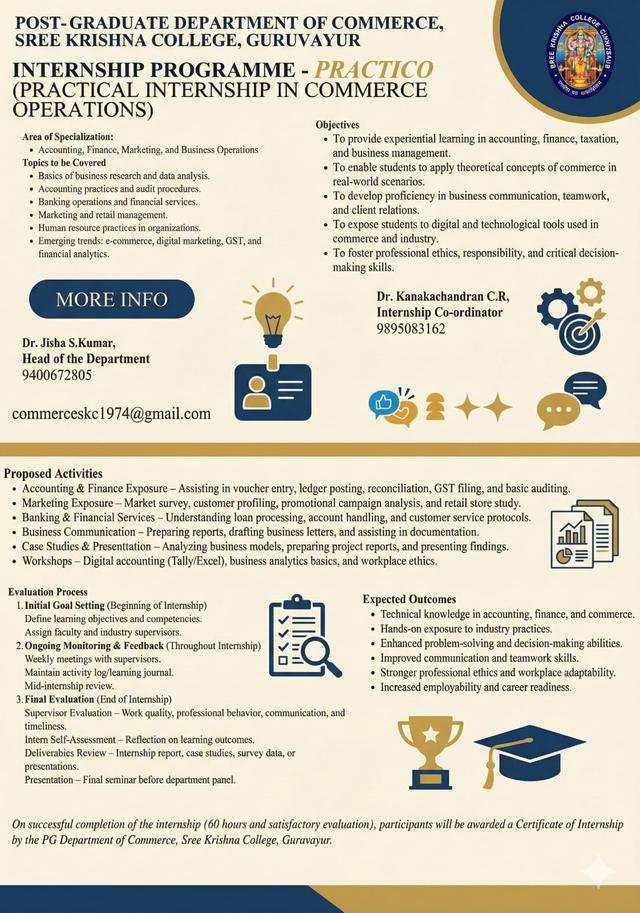

PRACTICO - Practical Internship in Commerce Operations
Programme Learning Outcomes for Undergraduate Internship
Application of Theoretical Knowledge
Ability to connect and apply academic concepts of commerce to real-world professional settings.
Professional and Technical Skill Development
Attain practical competencies in accounting, finance, taxation, auditing, marketing, and related business functions.
Problem-Solving and Critical Thinking
Demonstrate analytical and decision-making skills to address organizational and business challenges.
Communication and Interpersonal Proficiency
Convey ideas effectively in professional contexts, both in writing and speech, while collaborating productively with diverse stakeholders.
Ethical and Professional Conduct
Practice responsibility, integrity, and adherence to ethical standards in business activities.
Career Awareness and Planning
Gain awareness of industry expectations and use internship experience to shape personal career trajectories.
Workplace Adaptability
Show initiative, flexibility, and the ability to adjust to organizational culture, structure, and professional environments.
Topics to be Covered
- Basics of business research and data analysis.
- Accounting practices and audit procedures.
- Banking operations and financial services.
- Marketing and retail management.
- Human resource practices in organizations.
- Emerging trends: e-commerce, digital marketing, GST, and financial analytics.
Proposed Activities
- Accounting & Finance Exposure – Assisting in voucher entry, ledger posting, reconciliation, GST filing, and basic auditing.
- Marketing Exposure – Market survey, customer profiling, promotional campaign analysis, and retail store study.
- Banking & Financial Services – Understanding loan processing, account handling, and customer service protocols.
- Business Communication – Preparing reports, drafting business letters, and assisting in documentation.
- Case Studies & Presentations – Analyzing business models, preparing project reports, and presenting findings.
- Workshops – Digital accounting (Tally/Excel), business analytics basics, and workplace ethics.
Evaluation Process
- Initial Goal Setting (Beginning of Internship)
- Define learning objectives and competencies.
- Assign faculty and industry supervisors.
- Ongoing Monitoring & Feedback (Throughout Internship)
- Weekly meetings with supervisors.
- Maintain activity log/learning journal.
- Mid-internship review.
- Final Evaluation (End of Internship)
- Supervisor Evaluation – Work quality, professional behavior, communication, and timeliness.
- Intern Self-Assessment – Reflection on learning outcomes.
- Deliverables Review – Internship report, case studies, survey data, or presentations.
- Presentation – Final seminar before department panel.
Expected Outcomes
- Technical knowledge in accounting, finance, and commerce.
- Hands-on exposure to industry practices.
- Enhanced problem-solving and decision-making abilities.
- Improved communication and teamwork skills.
- Stronger professional ethics and workplace adaptability.
- Increased employability and career readiness.