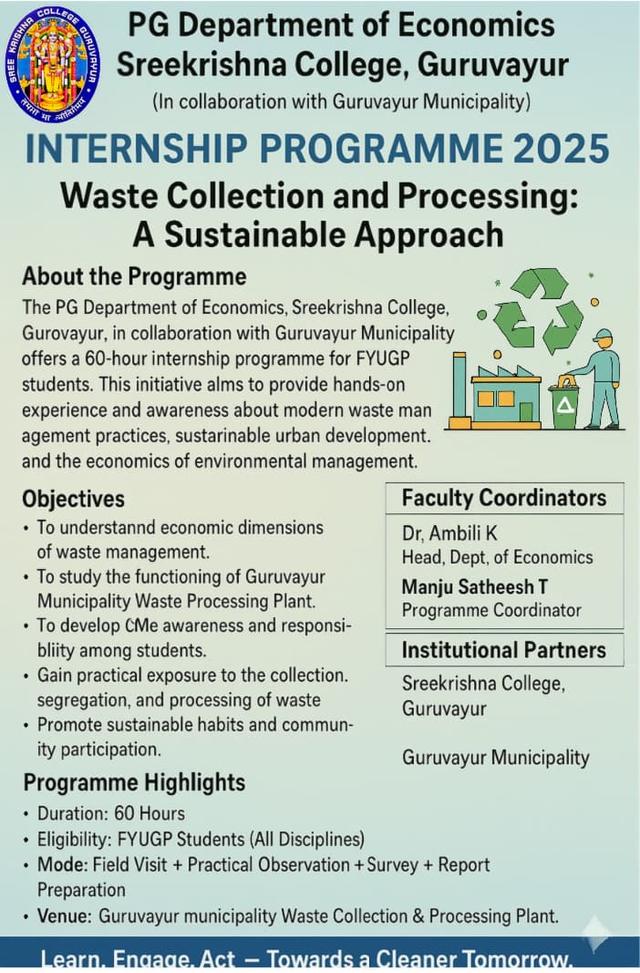


Internship in Economics
Programme Details
The Social Metrics Internship provided a hands-on opportunity to engage with the collection, analysis, and interpretation of data related to social behavior, public opinion, and community impact. Over the course of this internship, I worked closely with research professionals and data analysts to gather insights that inform social programs, advocacy strategies, and policy development.
The primary goal of the internship was to understand how quantitative and qualitative metrics can be used to assess social trends, measure program outcomes, and support evidence-based decision-making. Tasks included designing survey tools, conducting field or online surveys, analyzing response data using statistical software, and generating reports that translate data into actionable insights. This internship not only deepened my technical and analytical skills, but also provided a strong foundation in ethical data handling, inclusive research practices, and communicating findings to both technical and non-technical audiences. It was a valuable step toward a career in social research, impact evaluation, or data-driven public policy.
Objectives
- To understand the role of social metrics in evaluating societal trends, program effectiveness, and public opinion.
· To gain practical experience in designing and administering surveys, interviews, and other data collection tools.
· To develop skills in analyzing qualitative and quantitative data using tools such as Excel, SPSS, R, or Python.
· To interpret social data and generate reports that support evidence-based decision-making in social programs or policy.
· To learn ethical and inclusive practices in data collection, especially in diverse and sensitive populations.
Topics to be covered
What is research?
The types of research, Primary and secondary data sources,
scope of field survey,
how to conduct a field survey.
Proposed Activities
1. Designing Survey Instruments
o Assisted in developing questionnaires and interview guides to measure social attitudes, behaviors, and program impact.
2. Data Collection
o Conducted field surveys, online questionnaires, and structured interviews with target groups.
o Ensured data collection followed ethical guidelines and obtained informed consent from participants.
3. Data Cleaning and Management
o Entered and organized raw data using Excel, Google Sheets, or survey platforms (e.g., Google Forms, KoboToolbox).
o Identified and corrected inconsistencies, missing values, or duplicate entries.
4. Statistical Analysis
o Performed descriptive and inferential analysis using tools like SPSS, R, or Python.
o Created data visualizations (charts, graphs, dashboards) to highlight key trends and patterns.
5. Monitoring & Evaluation (M&E) Support
o Contributed to measuring Key Performance Indicators (KPIs) for ongoing social projects or community interventions.
6. Reporting & Documentation
o Drafted summaries, research briefs, and visual reports based on findings.
o Helped in preparing presentations for stakeholders and community partners.
7. Participating in Team Meetings
o Attended weekly research or M&E team discussions to review progress and troubleshoot field issues.
8. Literature Review & Benchmarking
o Conducted background research on social indicators and international best practices.
9. Ethical Research Training
o Participated in workshops or online modules on data privacy, consent, and responsible research practices.
10. Community Engagement
· Engaged with local stakeholders, NGOs, or community groups to better understand the social context of the metrics being studied.
Evaluation process
1. Initial Goal Setting (Beginning of Internship)
- Set clear learning objectives aligned with both intern expectations and organizational goals.
- Define specific competencies to be developed (e.g., data analysis, survey design, reporting).
- Identify a supervisor or mentor responsible for monitoring intern progress.
2. Ongoing Monitoring & Feedback (Throughout Internship)
- Weekly or biweekly check-ins with a supervisor to review tasks, address challenges, and provide guidance.
- Maintain a daily/weekly activity log or journal documenting completed tasks and learning reflections.
- Mid-internship self-assessment and supervisor evaluation to adjust workload or goals as needed.
3. Final Evaluation (End of Internship)
A comprehensive review that includes:
A. Supervisor Evaluation
- Work Quality – Accuracy and thoroughness of data collection, analysis, and reports.
- Technical Skills – Use of statistical software, survey tools, and data visualization.
- Communication – Clarity in presenting data insights, writing reports, and collaborating with the team.
- Professionalism – Punctuality, responsibility, initiative, and adaptability.
B. Intern Self-Assessment
- Reflection on skills gained and challenges faced.
- Evaluation of how well internship goals were met.
- Suggestions for improving future internship experiences.
C. Deliverables Review
- Evaluation of the intern’s final output(s), such as:
- Data sets or dashboards
- Survey tools developed
- Research report or presentation
- Monitoring & Evaluation contribution
D. Peer or Team Feedback (Optional)
- Brief input from colleagues who collaborated with the intern on team projects
Certificate or Letter of Completion
- Issued based on performance, attendance, and completion of required deliverables.
Expected outcomes
Expected Outcomes of a Social Metrics Internship
1. Technical Competencies Developed
- Proficiency in data collection tools such as Google Forms, SurveyMonkey, KoboToolbox, or Qualtrics.
- Basic to intermediate data analysis skills using software like Excel, SPSS, R, or Python.
- Experience in designing and refining social research instruments, including surveys, interview guides, and observation checklists.
2. Practical Research Experience
- Exposure to real-world social research methodologies including qualitative, quantitative, or mixed methods.
- Ability to manage and clean datasets for consistency, accuracy, and usability.
- Familiarity with ethical considerations in handling sensitive or personal data.
3. Communication & Reporting Skills
- Ability to translate data into insights through clear summaries, charts, dashboards, or reports.
- Improved presentation skills, both written and oral, tailored for different audiences (e.g., community stakeholders, managers, academics).
4. Applied Monitoring & Evaluation (M&E) Understanding
- Understanding of how social metrics are used in monitoring program performance or evaluating impact.
- Contribution to setting or tracking Key Performance Indicators (KPIs) in social development contexts.
5. Professional Growth
- Strengthened skills in teamwork, time management, and task prioritization.
- Increased confidence in working within a structured research or nonprofit environment.
- Development of a portfolio that may include reports, data visualizations, survey designs, and analytical summaries.
6. Networking and Career Orientation
- Establishment of connections with professionals in research, social development, or policy sectors.
- Clearer understanding of potential career paths in social research, data analytics, or public policy.