INTERNSHIP PROGRAMME ON FAUNAL DIVERSITY
For Life Science students (FYUG)
Programme Overview
- Name of the Internship Programme: Internship on Faunal Diversity
- Area of Specialization: Biodiversity
- Programme Coordinator: Dr. Santhosh P. P.
- Duration: 60 Hours (12 Days)
- Industry / Institution Linkage: BIOMES (Centre for Advanced Research and Education)
- Targeted Number of Participants: 10
- Eligibility Criteria: Undergraduate students
- Beneficiary Departments (Other than Parent Department): Life science students
PROGRAMME DETAILS
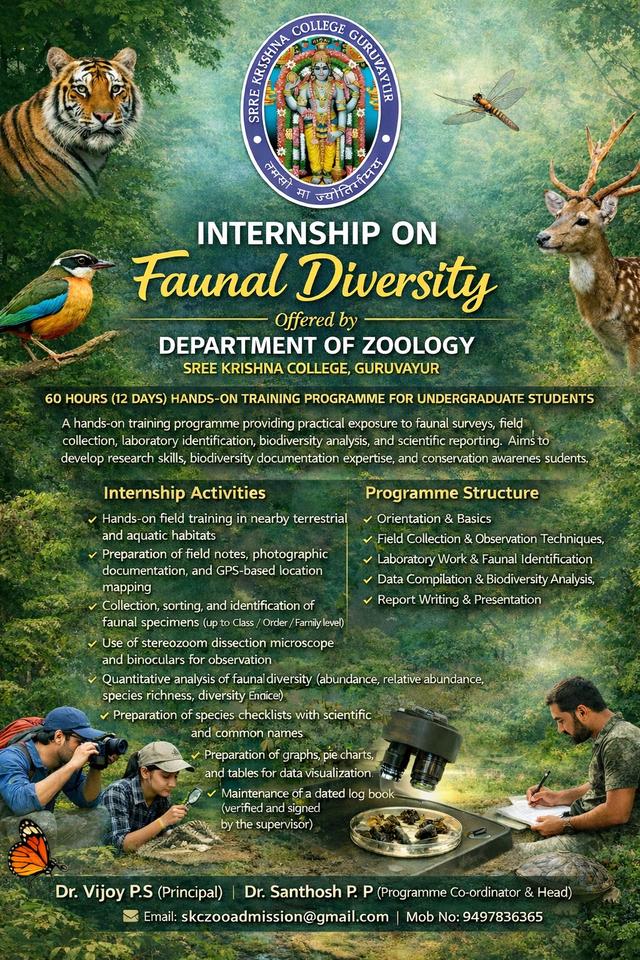
The Internship on Faunal Diversity, offered by the Department of Zoology, Sree Krishna College, Guruvayur, is a 60-hour (12-day) hands-on training programme for undergraduate students. It provides practical exposure to faunal surveys, field collection, laboratory identification, hands on training, biodiversity analysis, and scientific reporting. The programme aims to develop research skills, biodiversity documentation expertise, and conservation awareness among students.
PROGRAMME OBJECTIVES
- To introduce students to the diversity, distribution, and ecological significance of major faunal groups.
- To develop field skills in observing, identifying, and recording faunal species.
- To familiarize students with biodiversity documentation techniques and basic data analysis.
- To train students in scientific reporting, presentation skills, and the use of field guides and identification keys.
- To build research aptitude and employable skills related to wildlife documentation, biodiversity assessment, and conservation awareness.
PROGRAMME STRUCTURE AND SESSIONS
|
Session Component |
Nature of Training |
Hours |
|
Orientation & Basics |
Theory |
6 |
|
Field Collection & Observation Techniques |
Practical / Field-based |
25 |
|
Laboratory Work & Faunal Identification |
Practical |
13 |
|
Data Compilation & Biodiversity Analysis |
Practical |
8 |
|
Report Writing & Presentation |
Theory + Practice |
8 |
|
Total |
60 Hours |
INTERNSHIP ACTIVITIES
- Hands-on field training in nearby terrestrial and aquatic habitats
- Preparation of field notes, photographic documentation, and GPS-based location mapping
- Collection, sorting, and identification of faunal specimens (up to Class / Order / Family level)
- Use of stereozoom dissection microscope and binoculars for observation
- Quantitative analysis of faunal diversity (abundance, relative abundance, species richness, diversity indices)
- Preparation of species checklists with scientific and common names
- Preparation of graphs, pie charts, and tables for data visualization
- Maintenance of a dated log book (verified and signed by the supervisor)
- Preparation and delivery of oral or poster presentations before peers and faculty
EXPECTED OUTCOMES
Upon successful completion of the internship, students will be able to:
- Classify major faunal groups and identify common species in local habitats
- Conduct basic faunal field surveys using appropriate sampling techniques
- Maintain systematic records and prepare faunal species checklists
- Calculate and interpret biodiversity indices
- Prepare a scientific internship report and communicate findings effectively
EVALUATION AND ASSESSMENT
|
Component |
Weightage |
|
Log Book & Field Notes |
20% |
|
Field Work Participation |
20% |
|
Identification Skills |
20% |
|
Internship Report |
30% |
|
Presentation / Viva Voce |
10% |
|
Total |
100% |